WHAT IS dTMS?
Deep Transcranial Magnetic Stimulation, or Deep TMS, is an FDA-cleared treatment that delivers
magnetic pulses to areas of the brain associated with mood regulation.
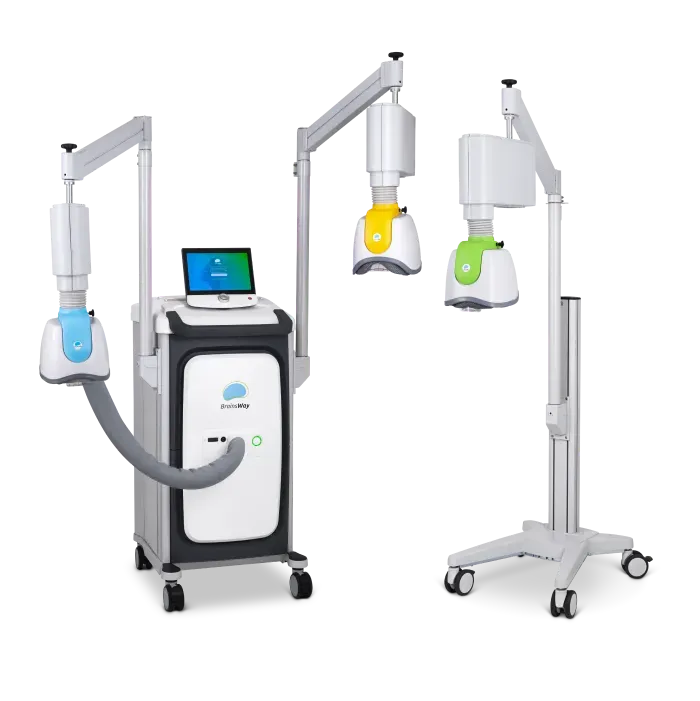
During treatment, you remain awake and sit comfortably while wearing a padded helmet containing a specialized magnetic coil.
Deep TMS does not require anesthesia or hospitalization, and most patients can return to their normal activities after each appointment.
HOW DOES dTMS WORK?
Deep Transcranial Magnetic Stimulation (dTMS), utilizing the BrainsWay H-Coil, technology is a non-invasive, outpatient therapy. It works by sending safe, targeted magnetic pulses to stimulate neurons in specific brain regions associated with mood control and regulation.
Unlike systemic treatments like medication, Deep TMS targets only the brain circuits that need healing, drastically reducing the risk of uncomfortable bodily side effects. Our clinic provides precise, customized Deep TMS mapping to ensure maximum therapeutic benefit.
WHAT ARE THE Positive Effects OF dTMS?
dTMS offers several benefits for treating depression and anxiety:
- It is safe and generally well-tolerated with minimal side effects, allowing patients to return to daily activities immediately after each session.
- dTMS has shown significant efficacy in reducing symptoms of depression, with improvements often surpassing those of traditional treatments.
- Patients often experience ancillary benefits, including reduced anxiety, enhanced sleep quality, decreased pain and increased energy.
- The treatment does not require hospitalization or anesthesia, and sessions typically last about 20 minutes.
WHO CAN Benefit FROM dTMS?
dTMS is ideal for individuals who have not responded adequately to antidepressants alone, or antidepressants combined with psychotherapy. It is well-suited for those seeking to manage symptoms without medication.
dTMS can be used with medications and psychotherapy as part of a comprehensive treatment plan.
Despite its efficacy, dTMS is not suitable for everyone. We will carefully assess physical, mental and emotional well-being before recommending whether or not dTMS fits into your individualized care plan.
REAL STORIES. REAL HEALING.
Real patient testimonials from the people who have restored hope.
Clarissa's Story
Joseph's Story
Emma's Story
READY TO EXPERIENCE LASTING Relief?
Take the decisive first step toward reclaiming your life from depression.
Find out if Deep TMS therapy is the right path for you.
WHAT MAKES dTMS DIFFERENT FROM TRADITIONAL TMS?
Traditional TMS typically uses a smaller coil placed against one specific area of the head. Deep TMS builds on the same non-invasive approach but uses an advanced H-coil housed inside a cushioned helmet. This specialized design is made to reach broader and deeper brain networks involved in depression, allowing treatment to go beyond the more focused stimulation used by traditional TMS.
Advanced Helmet Technology
The cushioned helmet delivers magnetic pulses to targeted brain networks while you remain awake and comfortable.
Broader, Deeper Stimulation
Deep TMS is designed to engage a wider area of the brain than traditional figure-eight TMS coils.
Designed to Fit into Daily Life
Treatment does not require anesthesia or a recovery period. Sessions are typically about 20 minutes, and most patients can return to work, drive, or continue their normal activities afterward.
Faq
dTMS THERAPY COMMON QUESTIONS
About Deep TMS
Who is TMS for?
TMS is often recommended for individuals with depression who have not found adequate relief from medication and/or therapy.
What is Deep TMS?
Deep Transcranial Magnetic Stimulation is a non-invasive technique using magnetic fields to stimulate nerve cells in the brain. It is FDA-cleared for depression, anxious depression and late-life depression.
How does dTMS work?
A magnetic coil placed against the scalp delivers targeted pulses that stimulate underactive brain regions associated with mood regulation.
Who is dTMS therapy NOT appropriate for?
Patients with any type of non-removable metal in their heads (except for braces or dental fillings) should not receive dTMS. Failure to follow this rule could cause the object to heat up, move, or malfunction and result in serious injury or death. The following is a list of metal implants that can prevent a patient from receiving dTMS:
- Aneurysm clips or coils
- Stents in the neck or brain
- Deep brain stimulators
- Electrodes to monitor brain activity
- Metallic implants in your ears and eyes
- Shrapnel or metal fragments in or near the head
- Facial tattoos with metallic or magnetic-sensitive ink
- Other metal devices or objects implanted in or near the head
Will I need to stop my medication or therapy?
Deep TMS treatment is safe to combine with any sort of medication or psychotherapy. Deep TMS is both noninvasive and found to be effective in treating a variety of mental health conditions, in combination with other forms of therapy or as a standalone treatment.
During Treatment
What does a session feel like?
You sit comfortably while feeling a tapping sensation on your scalp. Sessions last about 20 minutes. You remain fully awake and alert throughout the entire treatment.
Does Deep TMS hurt?
Deep TMS does not hurt. Most patients describe a mild tapping sensation. Any scalp discomfort typically subsides after the first week of treatment.
Can I drive after treatment?
Yes. No sedation is required for Deep TMS therapy. You can drive and return to normal activities immediately after your session.
Treatment Protocol
How many sessions will I need?
Standard protocol is 36 sessions over 6-8 weeks. Our Accelerated Deep TMS (SWIFT) protocol offers 30 sessions over just 6 days for rapid results.
When will I feel results?
Many patients notice improvement within 2-3 weeks. Full benefits typically emerge by the end of the treatment course.
Are results permanent?
Many patients experience sustained remission. Some may benefit from maintenance sessions. Results vary by individual.
Insurance & Cost
Will insurance cover Deep TMS?
Most commercial insurers and Medicare cover Deep TMS for treatment-resistant depression. Our team handles verification and prior authorization on your behalf.
What are the requirements for insurance coverage?
Typically, insurance requires having tried and failed 2 antidepressant medications and having engaged in psychotherapy before approving Deep TMS coverage.
HAVE MORE QUESTIONS?
Our team is here to answer any questions you have about Deep TMS therapy and help you determine if it’s right for you.
TMS vs. Medication
The world of mental health is constantly in flux as it attempts to offer patients battling various disorders the best and safest possible care. This is particularly true in cases of depression, with mental health professionals evaluating TMS vs. medication, as they weigh the benefits and contraindications of each treatment. Read on to find out more about these two popular therapy options.
DEEP TMS | MEDICATION
The left side column shows stats on TMS and the right shows stats on medication to treat depression
DEEP TMS | MEDICATION
82%
Response Rate
40%
Never Respond
65%
Remission Rate
66%
Don't Fully Recover
3 out of 4
Clinical Response
Over Half
Don't reach remission
HOW DEEP TMS TARGETS MOOD NETWORKS
The 3 Major Brain Networks in Mood Regulation
Mental health conditions like depression, anxiety, and addiction aren’t just the result of dysfunction in one isolated part of the brain. Rather, they involve imbalances and disruptions in interconnected brain networks—large-scale systems of communication between multiple brain regions. Modern neuroscience has identified three key networks involved in regulating mood and behavior: the Central Executive Network (CEN), the Default Mode Network (DMN), and the Salience Network (SN). Understanding these networks provides a deeper appreciation of how mental illnesses develop—and how innovative technologies like BrainsWay’s Deep Transcranial Magnetic Stimulation (Deep TMS) are uniquely positioned to treat them.
3 Major Brain Networks
Default Mode Network (DMN)
- Function: The DMN is active when we are at rest, daydreaming, thinking about ourselves, or ruminating. It’s essentially the brain’s “pacecar.”
- Brain Regions: Includes the medial prefrontal cortex, posterior cingulate cortex, precuneus, and hippocampus.
- Mental Health Relevance: Overactivity in the DMN has been linked to depression (especially rumination and negative self-focus), anxiety, PTSD, and obsessive-compulsive disorder (OCD).
Central Executive Network (CEN)
- Function: The CEN is responsible for high-level cognitive tasks like working memory, decision-making, reasoning, attention control, and goal-directed behavior.
- Brain Regions: Primarily includes the dorsolateral prefrontal cortex (DLPFC) and posterior parietal cortex.
- Mental Health Relevance: The CEN is often underactive in depression, leading to poor concentration, indecisiveness, and cognitive sluggishness. In addiction, dysfunction in this network can impair judgment and increase impulsivity.
Salience Network (SN)
- Function: The SN helps determine what information is relevant or “salient” and switches the brain’s activity between the DMN and CEN. It’s essential for emotional awareness and regulating desire and arousal.
- Brain Regions: Anchored in the bilateral insula and medial prefrontal cortex.
- Mental Health Relevance: Dysregulation in the SN is observed in depression, bipolar disorder, schizophrenia, and substance use disorders. It can result in inappropriate emotional responses and difficulty switching between internal thoughts and external focus.
TMS Targets Brain Networks
Historic views of mental illness focused on “problem areas” in the brain—like a faulty DLPFC in depression. However, research now shows that psychiatric disorders often arise from dysfunctional communication across entire networks. That’s why treatments that stimulate only a pinpoint region may miss the broader picture.
First-generation figure-8 TMS coils provide focal stimulation, targeting only a small, superficial area of the brain, below cortical surface, which may limit therapeutic impact. In contrast, BrainsWay Deep TMS uses a patented H-Coil design that penetrates deeper (1.8-2.0cm vs. 0.7-1.0cm) and stimulates broader neural circuits (18cm3 vs. 3cm3)1, reaching the interconnected networks responsible for these conditions2. By influencing a wider range of brain activity, Deep TMS may offer a more comprehensive and effective treatment approach.